Sourcing custom Pilates socks looks simple until you start comparing suppliers. Behind the same search term — “Pilates socks manufacturer” — hide three very different types of businesses, and picking the wrong one costs time, quality, and often a full production run.
Manufacturer, supplier, wholesaler: not the same job
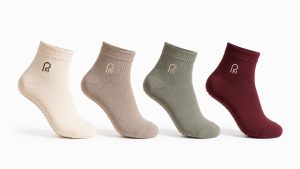
A wholesaler resells existing stock. No grip pattern changes, no colour matching, no logo integration — fine for a generic restock, useless the moment branding matters.
A supplier sits between you and a factory. Coordination without direct control: quality depends entirely on the factory the supplier chose, and you rarely get visibility into that relationship.
A manufacturer controls the full process — knitting, silicone grip application, quality control, packaging. It’s the only one of the three that can deliver a custom Pilates grip sock with your logo, your grip pattern, and your colours, produced in a small or medium batch rather than a generic run. For a studio or a wellness brand building a real identity, this is the partner worth finding.
What a real Pilates socks manufacturer needs to master
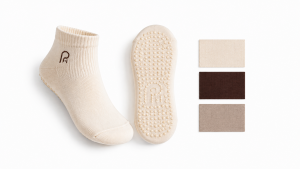
Technical knitting. Combed cotton for softness, polyamide and elastane for shape retention, flat toe seams to avoid pressure points during mat or reformer work. Generalist sock factories built for high-volume sportswear often miss these details entirely.
Grip application. Classic silicone dots, continuous silicone bands, or a custom pattern integrating your logo — grip can cover the full sole, focus on the toe and heel area, or follow a specific design. Density and consistency of the silicone directly determine traction on mat and reformer, and this is exactly the kind of detail that separates a specialist from a generalist.
Jacquard knitting and Pantone matching. A well-integrated logo isn’t embroidered as an afterthought — it’s knitted directly into the sock’s structure. A serious manufacturer works to exact Pantone matching against your brand palette, with up to several colours integrated during knitting.
OEM or private label: two different levels of ownership
OEM means starting from an existing sock design and applying your logo and colours on top. Fast and cost-efficient, but the underlying product stays close to what other brands already sell.
Private label means the sock is developed for your brand from the brief: fit, grip density, logo placement, material, and packaging are designed together. The result isn’t a generic product with your branding applied — it’s a signature model your clients won’t find elsewhere. For a studio or brand building a long-term identity, private label is almost always the stronger choice; OEM remains useful for testing a new market quickly before committing to a full development.
Four criteria before you commit
- MOQ. A manufacturer built for studios offers small and medium production runs, not wholesale-only volumes. This filters out most generalist factories immediately.
- Lead time. From raw yarn to a sock delivered in its packaging, expect several weeks between an approved sample and full production. A transparent manufacturer gives you this timeline before you order, not after.
- Sample validation. No serious order should start without a physical prototype — grip tested, colour checked, fit tried on.
- Quality control during production. Grip density, knitting consistency, colour accuracy: these should be checked by the manufacturer before shipping, not discovered by you on arrival.
Small and medium batches: why it matters for studios
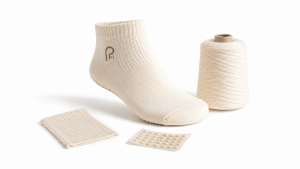
Most textile factories are calibrated for large volumes. An independent studio, a growing franchise, or a wellness brand testing a first collection rarely has the cash flow — or the need — to order thousands of pairs upfront. A manufacturer that accepts small and medium series lets you test a design, adjust grip or colour after real feedback from the floor, then scale once the product is validated, without locking capital into an oversized first order.
How a serious collaboration actually runs
The process is consistent across manufacturers who know what they’re doing: a brief on your brand identity and intended use (studio, reformer, hotel spa), a prototype built with your logo and grip pattern, a validation step before production starts, then quality control before shipping. Each stage of this process, with realistic lead times, is detailed on our process page — worth reviewing before you set a launch date.
A note on sourcing from a French-based manufacturer
Working with a manufacturer based in France, coordinating production in Europe or Asia depending on the technique required, offers a middle ground between fully local production and sourcing directly from an overseas factory with no intermediary oversight. Communication happens in your language and time zone, quality control is handled by a team accountable to you directly, and sample turnaround tends to be faster than negotiating each round-trip with a factory abroad on your own. For brands prioritising responsiveness and accountability over the lowest possible unit cost, this middle ground is often the more practical choice.
Our positioning
We manufacture custom Pilates socks for studios, coaches, hotels and spas, and wellness brands that don’t compromise on quality. Unlike a generalist supplier, we focus exclusively on Pilates: every detail — grip, knitting, packaging — is designed for this specific use, produced in small and medium batches. For deeper technical questions on materials, sizing, or branding techniques, our guides cover each topic in depth, and our FAQ answers the most common questions from studios reaching out for the first time. Our about page introduces our team and partner workshops.
Next step
Choosing a real manufacturer over a wholesaler or a generic supplier is what guarantees your custom Pilates socks actually reflect your brand — not a repackaged generic product with a logo added on top. If you’re preparing a launch for your studio, franchise, or wellness brand, request a quote: we reply within 48 hours with a proposal tailored to your volume and timeline.