A grip sock does one job first: keep a client stable on a mat or a reformer. Everything else — the logo, the colour, the packaging — comes second. Studios that get this order wrong end up with a beautifully branded sock that grips poorly, and clients notice the second one long before the first.
Grip comes before branding, always
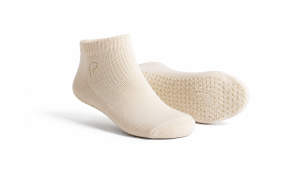
Silicone grip exists in a few configurations, and the choice affects both function and cost. Classic silicone dots offer reliable traction at a lower cost per pair — a solid default for most studio floors. Continuous silicone bands cover more surface and hold up better on high-friction reformer work, at a slightly higher production cost. A custom pattern integrating your logo directly into the grip layout adds a distinctive visual signature, but only makes sense once the base grip performance is already proven — branding a weak grip pattern doesn’t fix the grip, it just makes the flaw more visible.
What “custom” should actually mean here
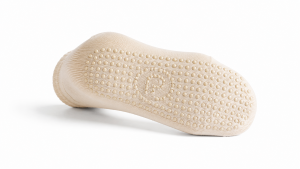
For a studio ordering branded grip socks, customisation covers four elements, not just the logo:
Grip placement. Full sole coverage suits general studio use. Toe-and-heel-only coverage suits a lighter, more minimalist feel favoured by some reformer practitioners. The right choice depends on your dominant class format, not on what looks best in a product photo.
Logo integration. Knitted directly into the jacquard structure for a flat, durable finish that survives repeated washing, or embroidered for a raised, more detailed result on a targeted spot like the ankle. Each technique suits a different logo complexity — a simple mark works well in jacquard, a detailed design usually needs embroidery to stay legible.
Colour matching. Exact Pantone matching against your studio’s brand palette, with several colours achievable within a single knitting run. Sending a rough colour reference instead of a precise code is the single most common cause of a mismatched final product.
Sizing range. A three-size range (roughly S/M/L, covering EU 35 to 44) covers most studio populations without overcomplicating stock management. A studio with a narrower client base can sometimes reduce to two sizes; a larger or more diverse membership benefits from keeping all three to avoid frequent stockouts at the extremes.
Bulk ordering: what changes at studio volume
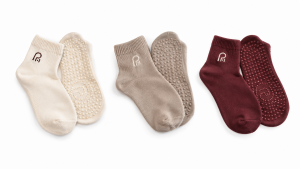
Ordering for an entire studio — enough pairs for a welcome pack programme, a retail corner, or a full team kit — shifts the conversation from a small test batch to a production run with its own logistics. At this volume, three things matter more than they did at sample stage:
Consistent quality across the full run, not just on the approved sample. Grip density and colour accuracy should be checked throughout production, not only on the first units off the line.
Realistic lead times. Bulk orders take longer than a small pilot batch, and a transparent manufacturer states this timeline upfront rather than leaving it vague until the order is already placed. Every stage of the process, from brief to shipping, is detailed on our process page.
Sizing distribution planned in advance. Ordering an even split across sizes without checking your actual client base often leaves you overstocked on sizes that don’t sell and short on the ones that do — worth reviewing your studio’s typical size distribution before finalising quantities.
Why studios choose custom over generic grip socks
A generic grip sock, bought off a catalogue with no branding, does the job functionally but leaves no lasting impression once the class ends. A custom grip sock worn during every session — and often carried home, to the gym, to another studio — becomes a recurring brand touchpoint that no flyer or online ad can match in frequency or intimacy. For a studio building a distinct identity across one or several locations, that repeated visibility is the actual return on the investment, not the sock itself.
Distinguishing this from OEM manufacturer sourcing
Studios ordering branded grip socks for their own floor are solving a different problem than a brand developing a manufacturer relationship for private label production. Here, the priority is a reliable, well-branded product delivered on a predictable schedule for internal or retail use — not building a standalone sock brand. That distinction matters when comparing offers: a supplier optimised for large private-label brand launches isn’t automatically the best fit for a studio ordering a defined batch for its own membership, and vice versa. Being clear about which of the two you actually need before requesting quotes saves a round of back-and-forth with suppliers built for the other use case.
Prototype before production, no exceptions
Regardless of order size, no production run should start without a validated physical sample. This is the only reliable way to confirm real-world grip performance, exact colour match, and logo legibility before committing to a full batch — correcting a flaw on one sample takes minutes; correcting it across a completed bulk order does not.
Our positioning
We manufacture custom Pilates socks with silicone grip for studios ordering in bulk, coaches testing a first small batch, and wellness brands equipping multiple locations. Every project goes through a validated prototype before production, produced in small and medium runs rather than oversized minimums. For deeper technical guidance on materials, sizing, or branding techniques, our guides cover each topic, and our FAQ answers the most common questions from studios ordering for the first time. Our about page introduces our team and partner workshops.
Next step
A grip sock only earns its branding once the grip itself performs — get that right first, then build your studio’s identity on top of it. If you’re preparing a bulk order or a first pilot batch, request a quote: we reply within 48 hours with a proposal tailored to your volume and timeline.